Catching defects before the segment goes on sale.

When a segment is released for sale, the operator starts selling a service it has committed to deliver. If the build behind it has defects, the cost does not stay in construction. BYNTGroup built and deployed the quality management platform that enforces the release gate across five build partners — field capture against the exact asset, back-office assignment, and reporting solid enough to hold a partner to.

The release-for-sale gate is the most expensive place to be wrong.
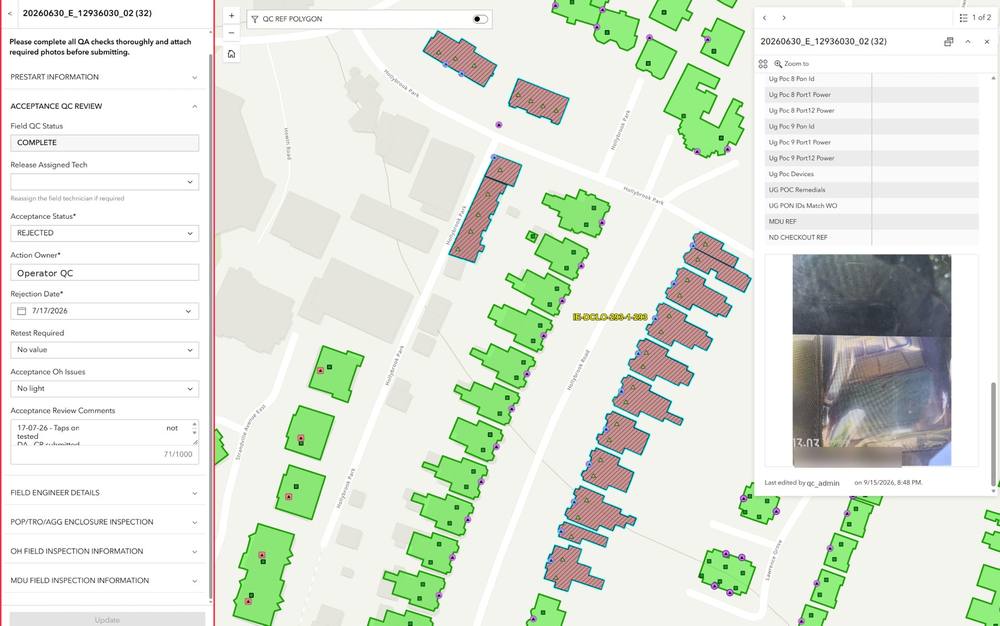
Acceptance review screen showing a segment marked rejected, beside a map of the inspected area and the field photograph attached to the finding
Fig. 1 — Acceptance review — a segment rejected, with the field evidence attached · Ireland

The work in figures

Src — National full-fibre upgrade programme, Ireland · as at September 2026
QC technician accounts on the platform, field-based40
— office-based support10
Inspections performed22,000
— caught a defect; an inspection can find one or more1 in 6
Issues captured3,560
Build partners covered5

What the gate is protecting

A defect found in construction costs what it costs to fix. The same defect found after release costs a failed install, a repeat truck roll, a missed activation date and, often enough, the customer — because by then somebody has already been promised something.

On this programme 52,300 homes had been constructed and 40,000 released for sale as at September 2026. The gap of about 12,300 homes is built but not yet released: those homes are pending testing or awaiting backhaul light. The operator needed the release gate enforced the same way across five build partners, with evidence behind every rejection solid enough to hold a partner to.

Capture against the asset, not against a spreadsheet

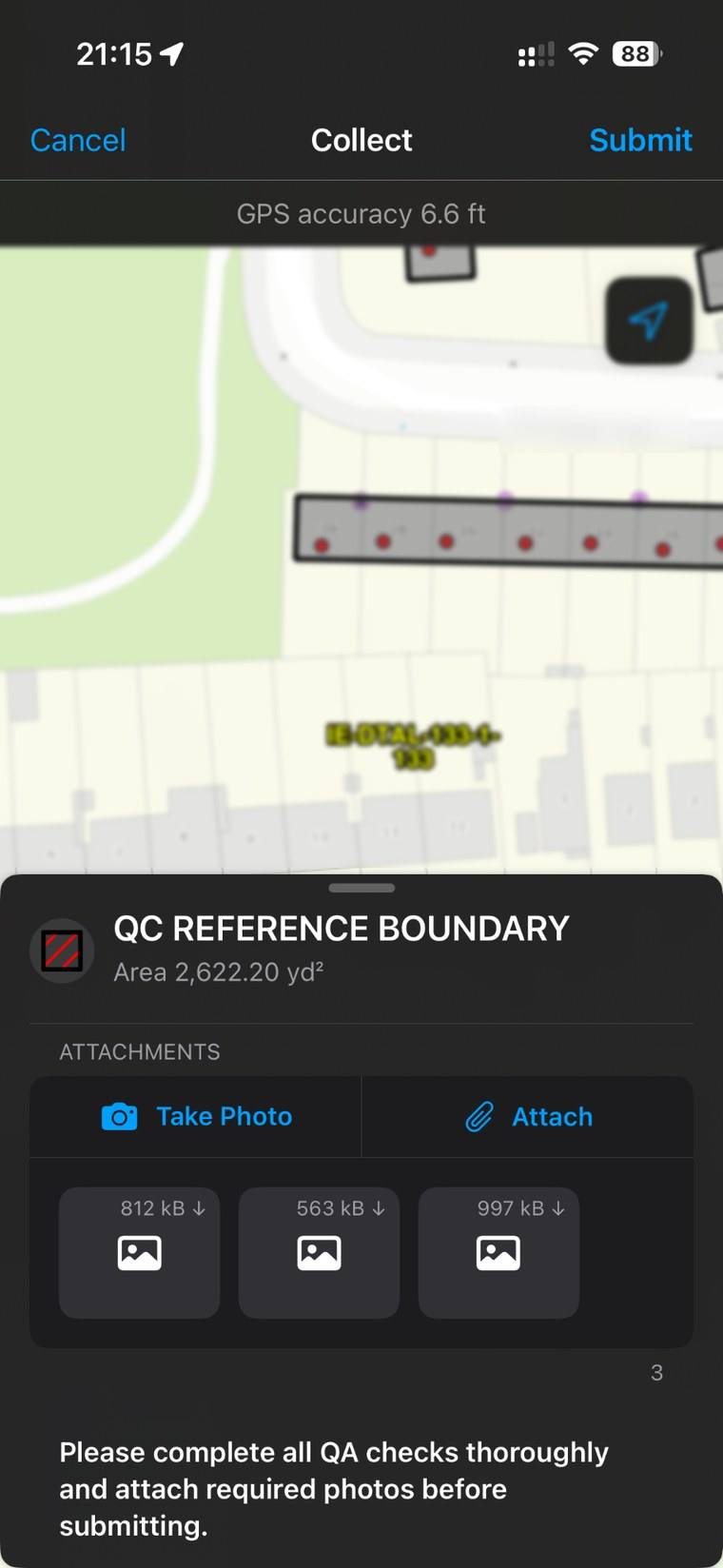
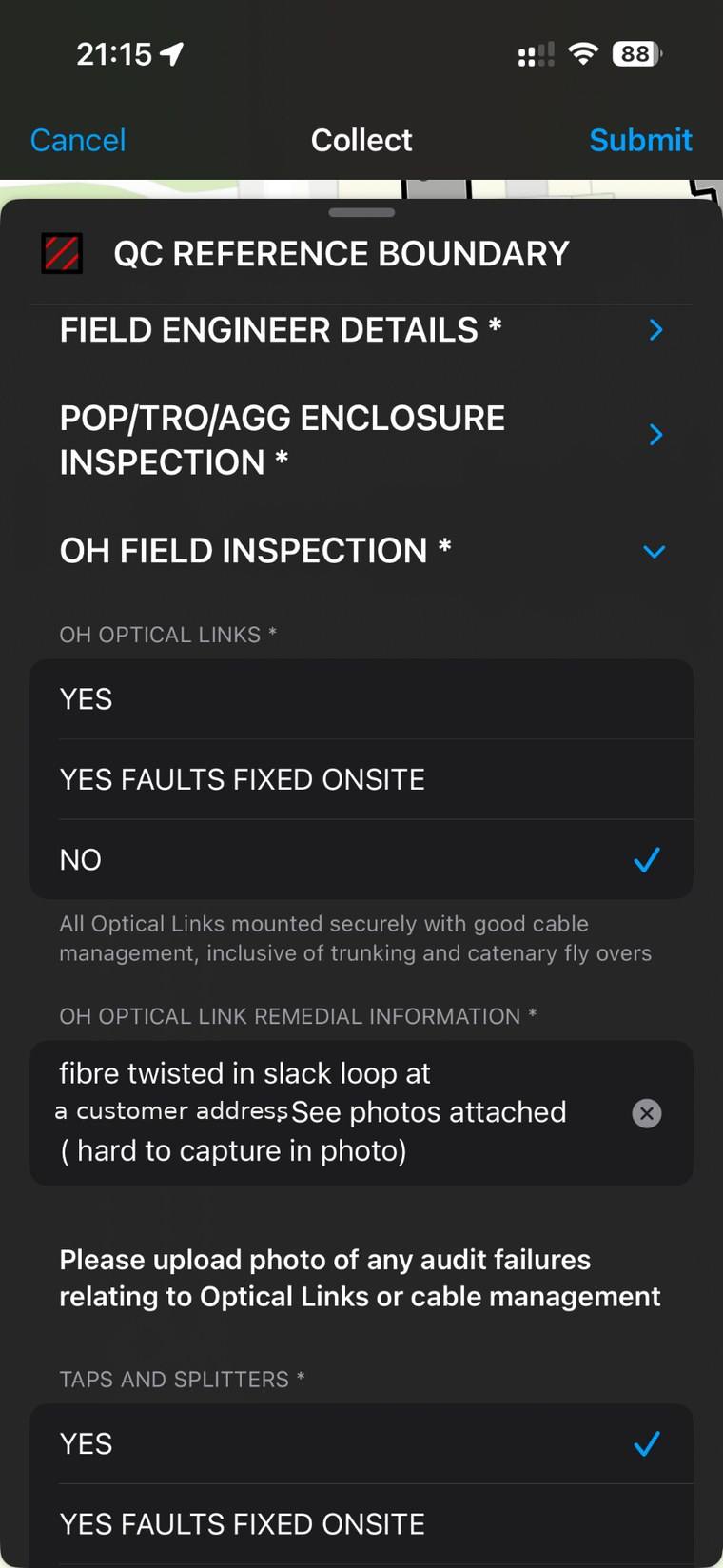
QC technicians work in ArcGIS Field Maps with structured inspection forms. An issue is recorded against the exact asset and location in real time, with the photograph attached at the point of capture rather than emailed in that evening from a phone gallery.

That single change is what makes the record defensible. A defect is tied to a segment, a partner and a date at the moment it is found, by the person who found it, standing in front of it.

Field Maps on a phone, showing a QC reference boundary drawn over a street of premises with photographs attached to the record
Fig. 2 — Collecting against the QC reference boundary
Structured inspection form on a phone with overhead optical link checks and a free-text remedial note
Fig. 3 — Structured inspection form, in the field

Assigning and managing the work

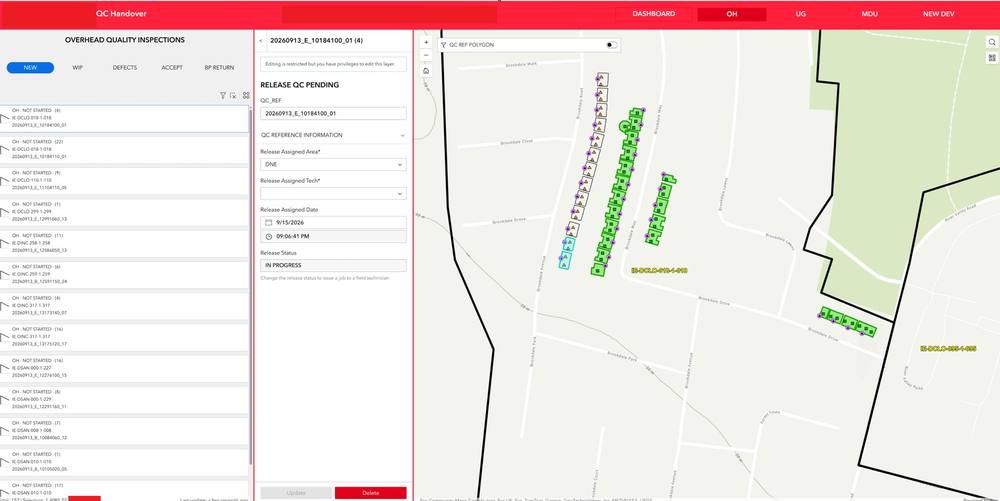
A back-office application assigns and manages inspections across the field team — what is new, what is in progress, what has come back with defects, what has been accepted, and what has gone back to the build partner. The queue is the programme, not a spreadsheet somebody maintains.

Back-office quality inspection queue beside a map of the inspection area, with a release record open for assignment
Fig. 4 — Inspection assignment and release status

Quality next to progress, not in a separate silo

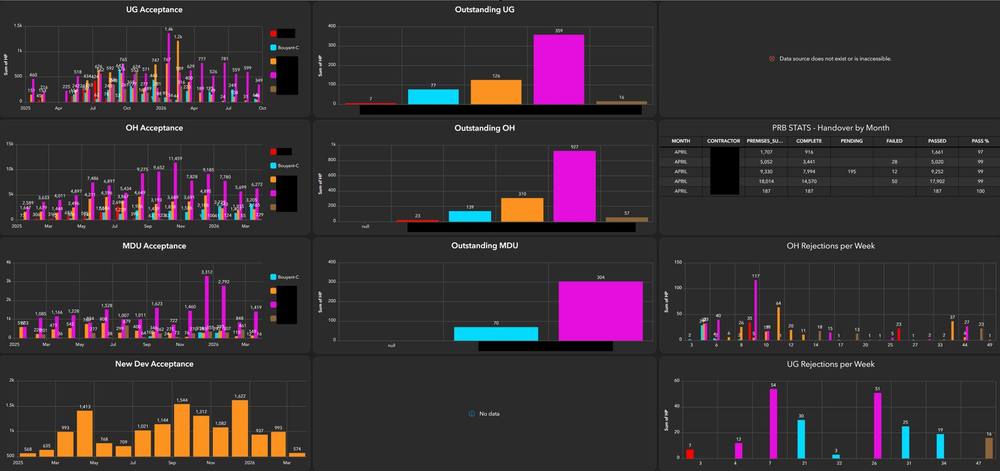
Captured issues flow into the operator’s own ArcGIS Enterprise environment and surface in Power BI alongside the rest of their internal reporting. Acceptance by month, outstanding work by build type, rejections per week, pass rate at handover — sitting next to build progress rather than in a quality report nobody opens.

Every defect is attributable to a partner, a segment and a date. That is what turns quality from an argument into a record.

Reporting dashboard with acceptance and outstanding volumes by build type, a handover pass-rate table and rejections per week
Fig. 5 — Quality reporting, inside the operator’s own environment

A gate with evidence behind it

The result is a release-for-sale decision made on data rather than on programme pressure. A segment goes on sale when the record says it is ready — and when it does not, the reason is attached to it.

The same programme, three times over

Build, then platform, then quality. Each one is the reason the next happened: BYNTGroup was building on the programme, built its own GIS platform to run its crews, was contracted to build that platform for every build partner, and was then asked to put quality control on top of it.

Where this goes next

Talk to us about quality on a build

Tell us about the programme and we will come back with a practical delivery plan.

Start a conversation